
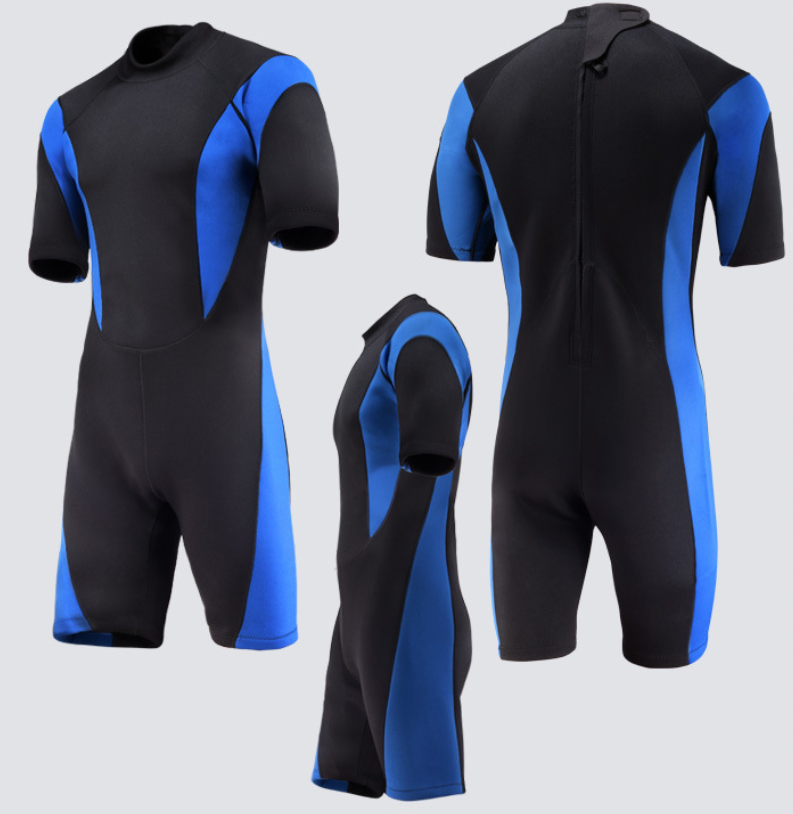
here are the complete manufacturing process of a wetsuit (primarily referring to mainstream wetsuits) in detail. This is a process that integrates materials science, ergonomics, and precision manufacturing techniques, designed to provide divers with crucial insulation, protection, and comfort.
Below is a detailed breakdown of the entire process from design to finished product:
——
Phase 1: Design and Development
This is the “brain” of the wetsuit manufacturing process, determining the final product’s performance and market positioning.
1. Market Positioning and Demand Analysis:
◦ Identify the target user: Is it for scuba diving, freediving, surfing, water sports, or military/industrial use?
◦ Determine the usage environment: Water temperature range (tropical, warm, cold water), intensity of use, etc.
2. Pattern Design and Development:
◦ Anthropometric Data Collection: Based on extensive anthropometric data, design basic patterns for different genders, body types (e.g., male/female/children), and fits (fitted/regular/loose).
◦ 3D Modeling and Sample Garment Production: CAD software is used for 3D pattern making, aiming to minimize wrinkles, increase flexibility at joints (such as knees and elbows), and ensure sufficient thickness in the torso and core areas to maintain core body temperature. An initial sample garment is then produced.
3. Material Selection and Testing:
◦ Core Material: The formulation, structure, and thickness of neoprene rubber are selected.
▪ Foaming Process: Open-cell (softer, more compressible, good insulation but water can penetrate) or closed-cell (more durable, provides additional buoyancy).
▪ Lining: The choice of inner lining material, such as nylon, polyester, high-elasticity fabric, or “skin-like” material.
▪ Outer Layer: The outer protective layer, such as abrasion-resistant nylon, super-elastic fabric, etc.
◦ Auxiliary Materials: Sewing thread, glue, zippers, Velcro, reinforcing strips, etc., are selected, requiring seawater resistance, UV resistance, high strength, and elasticity.
——
Phase Two: Material Preparation and Cutting
This is the transformation from raw materials to cut pieces, requiring extremely high precision.
1. Roll Inspection and Laying:
◦ Rolls of composite neoprene rubber material are transported to the factory for quality inspection.
◦ The material is laid out in multiple layers on a large cutting bed, sometimes dozens or even hundreds of layers, to improve cutting efficiency.
2. Computer-Aided Cutting:
◦ Mainstream Process: Cutting is performed using computer-controlled high-pressure water jets. The water jets are extremely fine and the pressure is extremely high, enabling laser-like precision cutting without generating heat or smoke. The cuts are smooth and do not melt or stick together the foamed rubber.
◦ Auxiliary Process: For some simple parts or small-batch production, computer-controlled vibrating knives or traditional die-cutting may also be used.
◦ The computer automatically optimizes the layout based on the design drawings, maximizing material utilization and reducing waste. The final product is cut pieces of various shapes.
——
Stage Three: Sewing and Assembly
This is the core step in transforming flat fabric pieces into three-dimensional garments, requiring advanced sewing skills.
1. Sewing Techniques:
◦ Plain Sewing: The most basic connecting seam.
◦ Blind Sewing: Using a special sewing machine, the needle only penetrates the surface of the fabric, not the lining, leaving almost no visible seam and better preserving the integrity of the lining.
◦ Elastic Stitches: Sewn using a four- or five-thread overlock sewing machine. The stitch itself is highly elastic, able to stretch synchronously with neoprene rubber without breaking.
2. Treatment of Key Areas:
◦ Seam Seaming: This is crucial for insulation performance! Simple sewing leaves countless tiny needle holes, allowing water to quickly flow in and out, carrying away body heat. Therefore, all seams need to be sealed with a special neoprene adhesive.
◦ Zipper Installation: Install special waterproof zippers at openings (such as the back, chest, wrists, and ankles). Multiple layers of reinforcement and bonding are applied around the zipper to prevent water ingress.
◦ Reinforcement and Abrasion Resistance Treatment: Additional abrasion-resistant reinforcements are heat-pressed or sewn onto high-wear areas such as the knees, elbows, shoulders, and hips.
——
Fourth Stage: Bonding and Finishing
This is the final processing step to enhance the performance and durability of the wetsuit.
1. Seam Bonding:
◦ Liquid neoprene adhesive is applied to the inside of the sewn seams. Through heating and pressure, it fuses with the fabric, forming a completely waterproof seal.
◦ Some high-end wetsuits use a combination of adhesive bonding and stitching reinforcement, achieving optimal waterproofing and structural strength.
2. Hot Pressing:
◦ Specific components (such as logos, reinforcements, and specific curved sections) are processed on a hot press to better conform to the human body.
3. Trimming and Quality Inspection:
◦ Excess threads and rough edges are trimmed.
◦ Full-process quality inspection: Every wetsuit undergoes rigorous inspection, including stitching quality, adhesive strength, zipper smoothness, and absence of defects. Some also undergo random sampling for watertightness and pressure testing.
4. Cleaning and Packaging:
◦ Clean the surface and attach labels and care instructions.
◦ Pack according to size and style, ready for shipment.
——
Core Technology and Process Highlights
• Seamless/Glue-bonded Technology: The highest-end wetsuits use a fully glued process, with most seams bonded with special adhesive, eliminating the need for stitches. This greatly reduces pinholes, achieving peak insulation, elasticity, and comfort. However, the process is complex and costly.
• Different Thicknesses for Different Areas: Professional wetsuits often employ a “gradient thickness” design. For example, 7mm for the torso for insulation, 5mm for the arms to maintain flexibility, and 3mm for the forearms for easy equipment operation.
• Special surface treatments: such as a “titanium alloy lining,” which reflects body heat radiation through a metallic coating, enhancing insulation; and a “smooth skin” surface, reducing water resistance.
Summary
The production of a high-quality wetsuit is far more complex than simple “cutting and sewing.” It begins with scientific design, involves high-precision material cutting, flexible and precise sewing, crucial sealing and bonding, and rigorous finishing. Every step embodies the ultimate pursuit of four core performance characteristics: insulation, protection, flexibility, and durability. It is this complex process that makes a professional wetsuit an important piece of technical equipment, not just a garment.

Leave A Comment