
This is an excellent question and a common source of confusion for beginner divers. The simple answer is:
A wetsuit should fit like a second skin, but it should never make you feel short of breath, in pain, or have restricted blood flow.
It needs to achieve a comfortable snugness. Below is a comparison chart to illustrate this visually:
flowchart TD
A [Wetsuit Fit Assessment] –> B [How does it feel to try it on?] B –> C [Feels “very comfortable, like wearing thick, tight clothing, allows for free movement”]
C –> D {Check key areas}
D — Neck, wrists, ankles –> E [Good seal, water cannot easily get in]
D — Armpits, knees, back –> F [No excessive wrinkles or air pockets]
D — Do chest expansion and squats –> G [No excessive pulling or binding feeling]
E & F & G –> H [✅ Perfect fit]
B –> I [Feels “a little tight, difficult to breathe deeply, tightness at joints”]
I –> J [❌ Too tight (choose one size larger or a more elastic style)]
B –> K [Feels “loose, there is space between the skin and the clothing, easy to move around”]
K –> L [❌ Too loose (choose one size smaller)]
Why does it need to be so tight?
The insulation principle of a wetsuit is to lock a thin layer of water between the body and the suit, using body heat to warm this layer. If the suit is too loose:
1. Cold water will constantly enter and exit, preventing the formation of a stable insulating water layer.
2. Insulation performance will drop drastically, making you feel very cold.
3. Increased drag will affect swimming efficiency.
How to determine if it’s “too tight” or “fitting”?
✅ This is what a “fitting but tight” suit looks like (√ Good sign):
1. Difficult but feasible to put on and take off: Requires some effort, but can be done independently or with assistance. Plastic bags can be used for assistance with the hands, feet, and mouth.
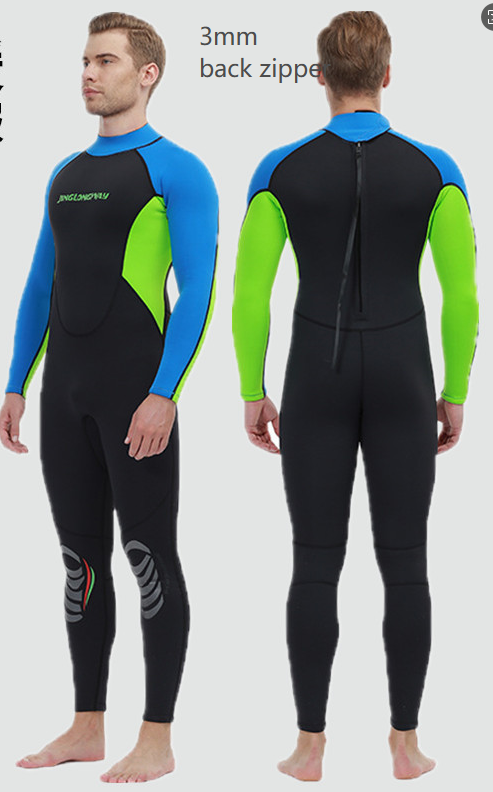
2. Evenly fitted all over: Like a taut layer of skin, without excess fabric or large wrinkles.
3. Sealed in key areas: Neck, wrists, and ankles are in close contact with the skin, making it difficult to insert fingers easily. This is crucial to prevent cold water from entering.
4. Fits snugly during activities: When performing chest expansions, raising arms overhead, or squats, the wetsuit will stretch with your body but won’t make you feel “constrained” or “unable to breathe.”
❌ These are warning signs of being “too tight” (× Need to be replaced):
1. Difficulty breathing: When standing normally, you feel pressure on your chest, making it difficult to take deep, complete breaths. This is the most dangerous sign!
2. Pain, numbness, or tingling: Persistent pressure and pain in the shoulders, armpits, groin, carotid artery, etc., or numbness in the hands and feet, indicates obstructed blood circulation.
3. Excessive constriction: Feeling like you’re “bound,” with significant discomfort and anxiety, unable to relax.
4. Dark red marks: After removing the wetsuit, dark red marks remain on the skin that don’t fade for a long time.
Special considerations for different body types
• Those with broad shoulders and well-developed pectoral muscles: Pay special attention to the feeling of pressure under the armpits and chest. Choose a “high-stretch fabric” or a “comfortable/loose fit” from the brand.
• For petite or slender individuals: Ensure that your wrists, ankles, and waist don’t get too wet due to excessive looseness. Sometimes a “semi-custom” style may be necessary.
• Choose thickness: A wetsuit 5mm or thicker will fit better in the water. If it feels “extremely tight” on land, it may be too restrictive underwater. Consider choosing a size up.
Golden Rule: Static fit, dynamic flexibility
• Static fit: Feels tight but can breathe normally.
• Dynamic fit: Can perform diving maneuvers (such as frog kicks, reading the computer, operating equipment) without hindrance.
Ultimate advice: Always try on a wetsuit before purchasing and simulate diving maneuvers in the store. If you’re near the edge of your size, it’s better to choose a slightly larger size, as an overly tight wetsuit is not only dangerous but can also instill a fear of diving. A well-fitting wetsuit is the foundation of comfortable and safe diving.

Leave A Comment