
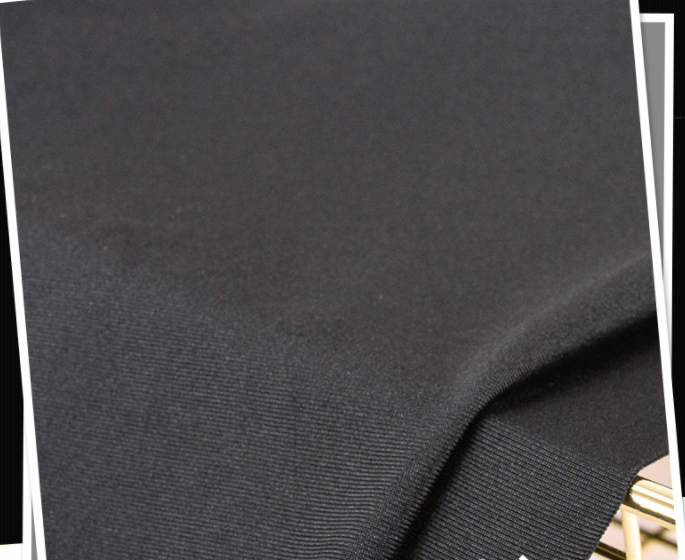
Okay, this is a very technical textile question. Simply put, four-way stretch fabric is a high-performance fabric that can achieve elastic stretch and comfortable rebound in four dimensions: warp and weft (longitudinal and transverse directions) and diagonal (oblique direction).
To understand this more clearly, we can compare it with traditional stretch fabrics:
Core Concept Explanation:
1. Two-way stretch fabric:
◦ Elastic direction: Typically, it only has good elasticity in the warp (longitudinal) and weft (transverse) directions.
◦ Common processes: Achieved by weaving or adding spandex (Spandex/Lycra) core-spun yarn into the fabric. This is the most common type of stretch fabric, such as regular stretch jeans and stretch T-shirts.
◦ Limitations: When stretched diagonally (oblique direction), the elasticity is weaker, which may cause a feeling of restriction.
2. Four-Way Stretch Fabric:
◦ Elasticity Directions: Excellent stretch and resilience in four directions: warp, weft, and two diagonal directions.
◦ Core Technology: Its secret lies primarily in its special knitting structure (especially weft knitting technology). Through precise loop structures and yarn combinations (often incorporating spandex), the loops can flexibly rotate and extend when the fabric is subjected to tension in different directions, creating a “multi-directional stretch” effect. Sometimes this is also achieved through special woven structures.
◦ Core Advantages: Provides unparalleled freedom and comfort, perfectly conforming to the various complex curves and movements of the body.
Main Features and Advantages of Four-Way Stretch Fabric:
• Ultimate Comfort and Freedom of Restriction: This is its greatest advantage. No matter how the body bends, twists, or stretches, the fabric can flexibly deform accordingly, without any tightness or restriction, like a “second skin.”
• Superior fit and shaping effect: It conforms to the body’s curves 360 degrees, making it especially suitable for compression sportswear, shapewear, and high-end underwear. It is smooth, wrinkle-free, and has a clean, streamlined appearance.
• Excellent mobility: It provides all-around support for high-intensity, multi-directional movements (such as yoga, Pilates, cross-training, and dance), reducing energy loss or movement distortion caused by clothing restrictions.
• High resilience and shape retention: High-quality four-way stretch fabrics retain their original shape well after repeated stretching, resisting sagging, buckling, or deformation, and offering excellent durability.
• Good breathability and comfort: Due to its typically more three-dimensional or breathable structure, its breathability is often superior to some thicker two-way stretch fabrics.
Common applications:
1. High-performance sportswear: Yoga pants, sports bras, compression training wear, dancewear, swimwear, etc. This is the most widespread application of four-way stretch.
2. High-end underwear and shapewear: Underwear, panties, and shapewear that prioritize ultimate comfort and a seamless experience.
3. Fashionable casual wear: High-end casual pants, jeans, dresses, T-shirts, etc., emphasizing a combination of comfort and style.
4. Medical and compression clothing: Medical bandages, compression stockings, etc., requiring even pressure without hindering movement.
5. Outdoor and functional clothing: Outdoor climbing and cycling apparel requiring high flexibility.
Difference from “Four-way stretch” (Important concept clarification):
In the market, the terms “four-way stretch” and “four-dimensional elastic” are often used interchangeably, but in professional contexts, there are subtle differences:
• Four-way stretch: Focuses more on describing woven fabrics, referring to fabrics with spandex yarns incorporated in both the warp and weft directions, resulting in elasticity in two directions. Its diagonal elasticity usually comes from the combined effect of warp and weft elasticity, but may not be as strong as a dedicated four-way stretch structure.
• Four-way stretch: This refers to the multi-dimensional elasticity achieved through the special loop structure of knitted fabrics. Its diagonal elasticity is active and structural, often superior.
However, in current commercial promotion, the two terms have essentially become synonymous, both used to emphasize the fabric’s all-around elasticity.
In summary, four-way stretch fabric represents high-end technology in stretch fabrics. Through precise textile structure design, it achieves a leap from “elastic” to “all-around freedom of movement,” making it a key material for modern functional clothing seeking ultimate comfort and performance.
Leave A Comment