
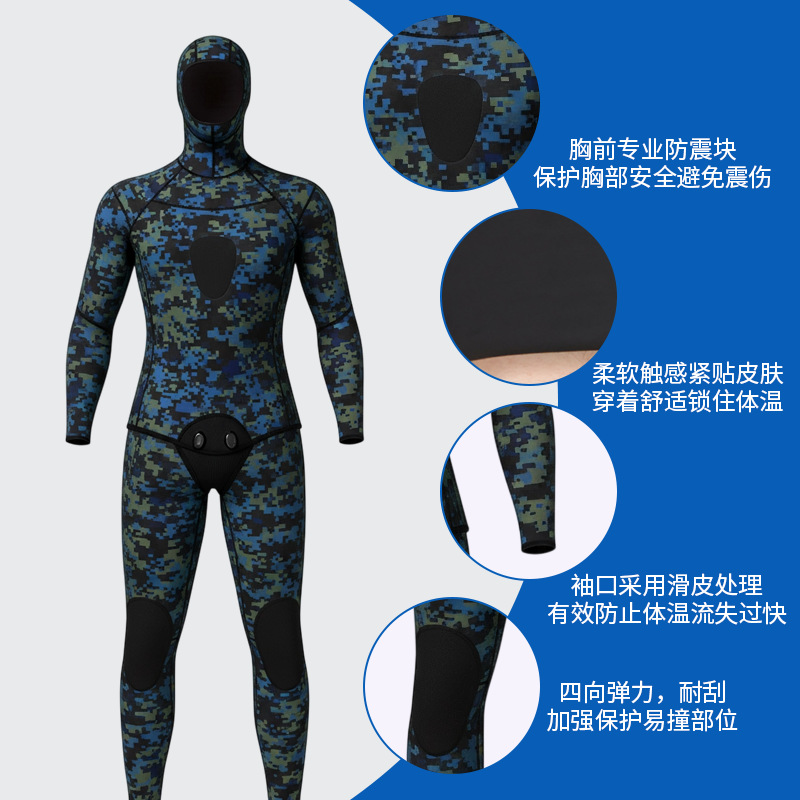
The principle behind wetsuit insulation isn’t simply “blocking the cold,” but rather a sophisticated thermodynamic engineering process. Its core lies in utilizing the physical properties of materials to minimize heat loss from the body.
The human body loses heat 25 times faster in water than in air, making insulation crucial. Different types of wetsuits have different focuses in their principles, but the core objective remains the same.
I. Core Principles: Three Ways to Combat Heat Loss
Body heat is primarily lost in water through the following three methods:
1. Conduction: Heat is directly transferred from a hotter object (your body) to a colder object (water). This is the primary method of heat dissipation.
2. Convection: As water flows, it continuously carries away the slightly warmer layer of water near your body, allowing fresh, cool water to continuously contact your skin, accelerating heat conduction.
3. Evaporation: After leaving the water, the evaporation of water from the skin’s surface carries away a significant amount of heat (this is why you feel colder on land).
Wetsuits primarily protect against “conduction” and “convection.”
——
II. Detailed Explanation of the Insulation Mechanisms of Different Wetsuits
1. Wetsuit: Utilizing “Still Water” as an Insulation Layer
This is the most common and ingenious principle.
• Step 1: Locking in a layer of water.
A wetsuit is not completely waterproof. When you enter the water, a small amount of seawater will enter the gap between the wetsuit and your body.
• Step 2: The body heats this layer of water.
Your body temperature will quickly heat this thin layer of water (approximately only 200-300 ml), bringing it close to your body temperature (e.g., to 30°C+).
• Step 3: Insulating materials prevent heat loss.
◦ Neoprene is key: This material is filled with thousands of tiny, closed nitrogen bubbles. Gases are poor conductors of heat (very low thermal conductivity), so these bubbles form a highly efficient insulating layer, greatly slowing down the rate at which body heat is conducted through the wetsuit material to the cold water outside (which may only be 10°C).
◦ A good fit is key: Wetsuits must fit very snugly. If they are too loose, the water inside will flow freely (increasing convection heat loss), and with fresh, cold water constantly entering, the body needs to constantly reheat it, leading to rapid hypothermia. A well-fitting wetsuit minimizes the flow and exchange of water inside.
Simple analogy: A wetsuit is like a thermos; your body is the hot water, the heated water layer is the inner liner, and neoprene is the vacuum insulation layer of the thermos.
2. Drysuit: Ultimate Isolation, Creating a “Miniature Diving Chamber”
Drysuits work on a more direct principle: completely eliminating water contact with the skin.
• Absolute Sealing: Neck closures, wrist closures, and waterproof zippers ensure that no water enters the inside of the wetsuit. Your body remains dry at all times.
• Doesn’t insulate itself, but creates an insulated space: The drysuit itself (such as the membrane material) has poor insulation properties; its function is to provide a dry, sealed space.
• Relying on thermal underwear: You need to wear specialized thermal underwear (such as fleece, wool, or high-tech aerogel suits) as an inner layer. The fibers of these garments trap air, and still air is an excellent insulator. Your body temperature heats the air between the underwear fibers, forming a stable “air insulation layer.”
• Inflatable and adjustable: In deep water, you can inject a small amount of gas (usually air) into the drysuit through a valve on your chest to balance the water pressure and prevent compression. This gas also enhances the internal insulation.
Simple analogy: A drysuit is like a “miniature manned submersible”; you sit inside wearing a thick sweater, completely isolated from the cold water outside.
3. Semi-dry suit: A “reinforced sealed version” of a wetsuit
The principle lies between the two, using enhanced sealing (high collar, tighter cuffs/legs, waterproof zippers) to minimize water ingress and flow, thus making the heated inner layer of water more stable and reducing heat loss due to convection.
——
III. How Materials Technology Improves Insulation
1. Composite Fabrics: Modern high-end wetsuits feature a smooth nylon/polyester outer layer (more durable and reduces water friction), an inner layer of ultra-elastic and soft spandex (for a closer fit), and a high-quality neoprene core. This structure ensures insulation while improving fit, which is fundamental to warmth retention.
2. Different Linings:
◦ Smooth Lining: Easy to put on and take off, but allows slightly more water exchange.
◦ Fleece Lining: Better at “locking in” a non-flowing film of water and increasing comfort; the mainstream choice.
◦ Titanium Alloy, Ceramic, etc. Coatings: Some high-end fabrics incorporate reflective coatings that reflect body heat back, improving insulation efficiency.
3. Technology:
◦ Glued blind seams/liquid-tight seams: Compared to traditional needle-stitched seams, these technologies seal the needle holes at the seams, significantly reducing cold water seepage (i.e., “flushing”), which is crucial for insulation.
Summary and Comparison
Type | Core Insulation Medium | Principle | Analogy
Wet Suit | Stagnant water heated by the body | Utilizes neoprene bubbles for insulation, slowing heat transfer from the internal hot water. | Insulated Water Bottle
Dry Suit | Still air layer | Completely waterproof, relies on thermal underwear to lock in air and form an insulation layer. | Miniature Diving Capsule
Semi-Dry Suit | More stable heated water | Optimizes the wet suit principle by strengthening the seal and reducing water circulation. | Enhanced Insulated Water Bottle
Therefore, a wetsuit is not a “heater,” but a “heat retainer.” Its entire design—from materials and thickness to cut and manufacturing processes—is aimed at creating an efficient insulation system that allows the body’s own heat to dissipate as slowly as possible. That’s why a well-fitting, high-quality wetsuit is absolutely crucial for safely enjoying diving in cold water.

Leave A Comment