
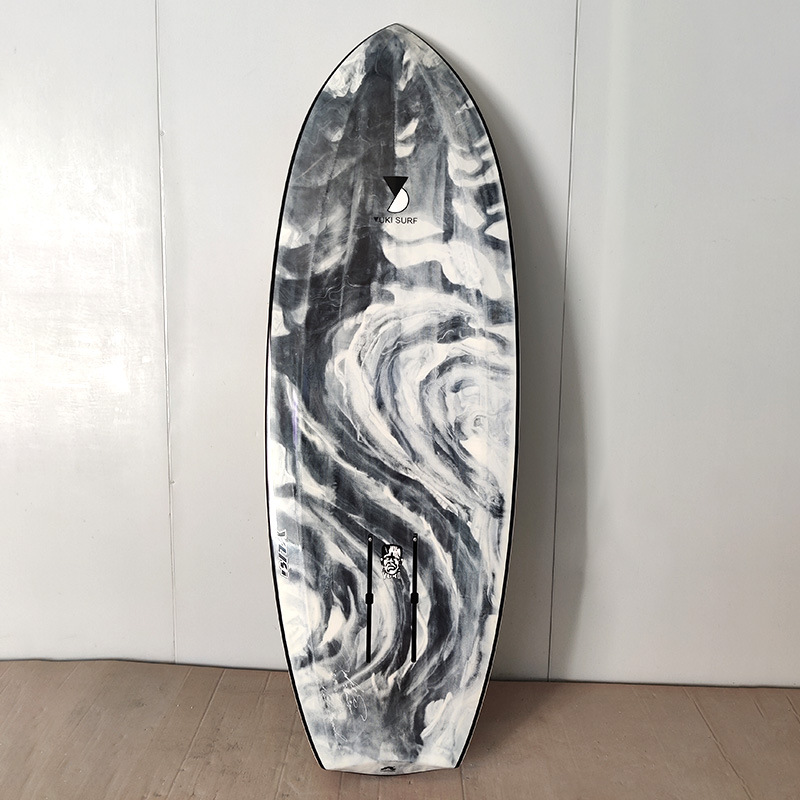
What is a hydrofoil surfboard?
A hydrofoil surfboard, often referred to as a foil, is a surfboard with hydrofoils attached to the bottom of the board. Hydrofoils resemble fins with wings and consist of a mast, fuselage, front wings, and rear wings. When the surfboard reaches a certain speed on the water, the hydrofoils utilize Bernoulli’s theorem and the principles of fluid mechanics to create a pressure difference between the upper and lower surfaces, generating lift and lifting the board and the surfer out of the water.
Hydrofoil surfboards can be divided into two types: unpowered and powered. Unpowered hydrofoils primarily rely on energy generated by waves, wind, or the body’s movement to propel them forward. They are suitable for use in choppy or light windy conditions and require advanced surfing skills. Powered hydrofoils, most commonly electric hydrofoils, are equipped with an electric motor for additional power. This eliminates traditional surfing’s reliance on natural waves and wind and can be used even on calm waters such as lakes and rivers, greatly expanding the scope of surfing.
This type of surfboard offers many advantages. In terms of performance, hydrofoils offer increased speed due to reduced friction with the water surface. They can also be used in smaller waves or light winds, giving surfers a unique flying-like sensation and greater control. Environmentally friendly, non-powered hydrofoils rely entirely on natural forces, and electric hydrofoils are cleaner than fuel-powered watercraft. However, hydrofoil surfboards also present some challenges. For example, their technical principles are relatively complex, making mastering balance and control difficult for beginners and requiring time and practice. Furthermore, due to the specialized hydrofoil structure and/or powertrain, they generally cost more than standard surfboards.


Leave A Comment