
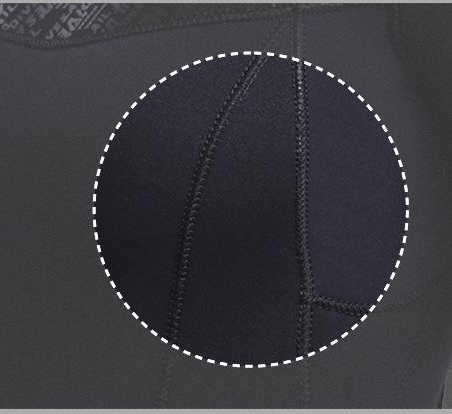
The sewing process of a diving suit directly affects its waterproofness, durability and comfort. Common sewing types and characteristics are as follows:
- Plain Stitch
Technology characteristics: The most basic sewing method, which is to sew the fabric by interweaving two threads, and the stitches are smooth.
Applicable scenarios: Non-waterproof areas or inner lining sewing (such as the initial fixation of cuffs and collars).
Disadvantages: Poor waterproofness, water easily penetrates from the thread holes, and is not suitable for the main waterproof parts of diving suits.
- Overlock Stitch
Technology characteristics: Use multiple threads to cover the edge of the fabric, and complete the sewing and locking at the same time, and the stitches are mesh-shaped.
Applicable scenarios: Locking the edge of the fabric (to prevent burrs), or areas with low waterproof requirements (such as non-sealed linings).
Waterproofness: It needs to be used with waterproof tape or coating treatment before it can be used on the outer layer of a diving suit.
- Flatlock Stitch
Technology features: The seam is located on the inside of the fabric, with a flat surface to reduce friction and foreign body sensation.
Applicable scenarios: The body layer or the part where external friction needs to be reduced (such as the inner seam of a diving suit).
Waterproofness: Waterproofness is insufficient when used alone, and waterproof tape is required to cover the seam.
- Taped Seam
Technology features:
First sew the fabric, then cover the seam with waterproof tape (such as PU tape, TPE tape), and seal the thread hole by high-temperature pressing.
The tape can be covered on the inside (internal tape) or outside (external tape) of the fabric.
Applicable scenarios: The core waterproof part of the diving suit (such as the main seams of the torso and limbs).
Advantages: Completely sealed seams, extremely strong waterproof performance, is a necessary process for professional diving suits.
Common types:
Half-taping: only covers one side of the seam (inside or outside).
Fully glued: Both the inside and outside sides are covered with glue strips, which is more waterproof (mostly seen in high-end diving suits).
- Blind Stitch
Technology features: The stitches are hidden in the fabric interlayer, there is no obvious thread on the surface, and only a small number of pinholes are exposed on the edge.
Applicable scenarios: areas with high requirements for appearance or where water resistance needs to be reduced (such as competitive diving suits, free diving fabrics).
Waterproofness: Need to use glue strips or coatings to deal with pinholes, otherwise water may still seep in.
- Welded Seam
Technology features: Directly bond the fabric through high-frequency hot pressing or ultrasonic welding, no stitches are required, and there are no holes at all.
Applicable scenarios: high-end waterproof diving suits or dry diving suits, pursuing extreme waterproofness and reducing weight.
Advantages: 100% waterproof, no risk of pinhole leakage, smooth surface to reduce water resistance.
Disadvantages: complex process, high cost, and special equipment required.
- Double Stitch
Technology features: Use two parallel stitches to reinforce the seams and enhance the pull resistance.
Applicable scenarios: Parts with greater force (such as shoulders and crotch), or the edges of taped seams that require secondary reinforcement.
Waterproofness: Taping is required, and simple double stitching cannot be waterproof.
Key factors in choosing sewing threads
Waterproof requirements: Taped seams or welded seams must be used in the core waterproof area, and ordinary seams must be sealed with tape.
Freedom of movement: Joints (such as armpits and knees) need to choose stitches with good elasticity (such as inner seams + elastic tape) to avoid restricting movements.
Durability: High-frequency use or high-intensity scenarios (such as industrial diving) require double stitches or thickened tapes for reinforcement.
Fabric compatibility: Light and thin fabrics (such as neoprene films) are suitable for blind stitching or welding, and thick fabrics (such as 5mm neoprene) require thick threads + taping.

Leave A Comment